这个男人来自地球
北控两人被驱逐:孟子凯挑衅陈盈骏拉拽曾凡博 里勒6犯+吃T失控_我的网站

一 |
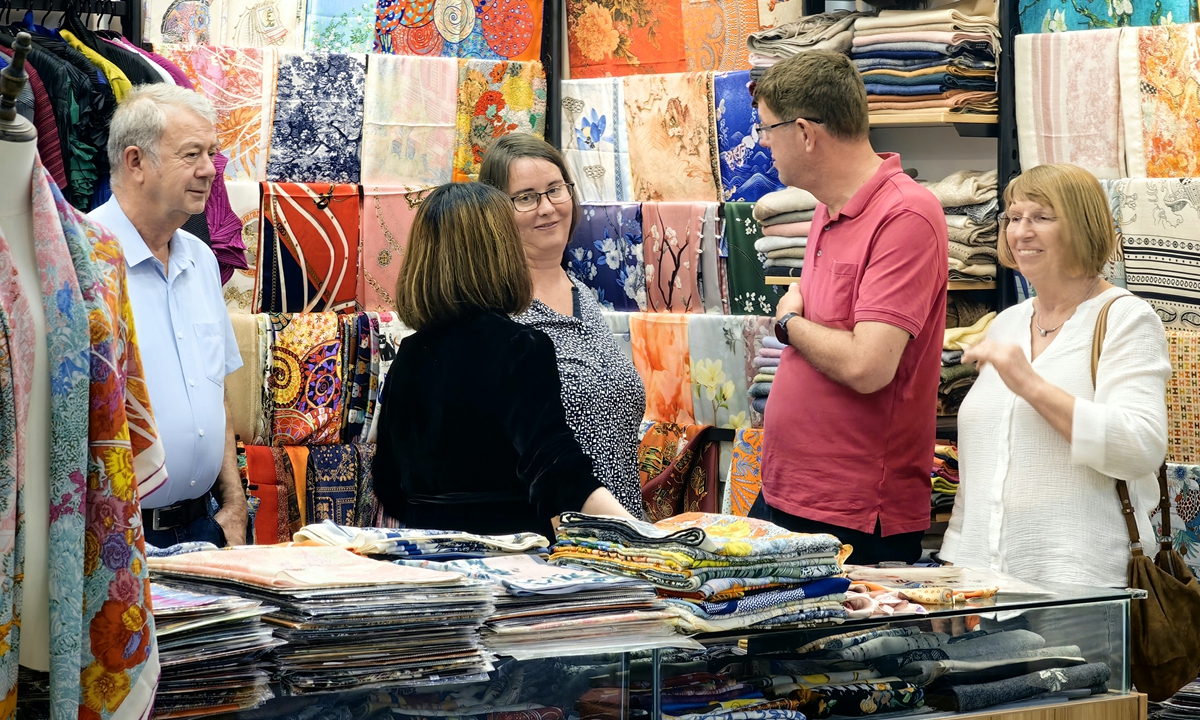
Foreign tourists explore customized clothing services at the South Bund Soft Spinning Material Market in Shanghai. Photo: VCG
For many overseas travelers arriving in Shanghai, the Bund and the Oriental Pearl Tower are no longer the first stops on their itineraries. Instead, they head straight to the South Bund Soft Spinning Material Market, where custom-tailored outfits have become a signature experience driving "Chinamaxxing," a viral lifestyle trend popular among global travelers.
The market buzzed with energy, with conversations in various foreign languages echoing across storefronts, when a Global Times reporter visited it on a work day.
Tourists from different countries take body measurements, browse design references, and discuss tailoring preferences with local shopkeepers.
Evolving from the time-honored Dongjiadu cloth market, the area now hosts more than 280 fabric vendors and tailor studios, forming a complete industrial ecosystem for custom apparel.
Inside one local shop, two foreign tourists excitedly tried on a series of Tang-style garments, taking photos of their favorite looks before professional tailors record precise measurements for their custom-fit clothing.
Gabbo, an Italian traveler, told the Global Times that he first discovered the market through TikTok and Instagram. As silk markets in Shanghai have grown popular among Italian tourists, he and his travel companion Nicco came specifically to shop for authentic traditional Chinese garments and premium silk pieces.
"I picked out a brown Tang-style jacket and a white shirt, while Nicole got matching white shorts. We wanted to try something new and plan to wear our custom outfits out tonight because the styles are very fashionable," Gabbo said. "The bespoke measuring service is professional and thoughtful, and the whole shopping experience has been wonderful."
Intl tourists emerge as a major forceBenefiting from China's visa-free policy covering Italy, the pair only needed to submit standard tourist documents for entry. They plan to stay in China for roughly two weeks to explore local culture and lifestyles.
Local tailor shop owners have witnessed a striking surge in overseas customer demand. Driven by expanded visa-free policies and viral social media exposure, growing numbers of foreign tourists come to the market for original Chinese-style custom clothing.
According to shop owner Li, international visitors now account for 30 to 40 percent of her clientele, a dramatic reversal from previous years when domestic customers dominated orders.
"We source fabrics directly from suppliers and hire in-house tailors to eliminate middleman markups. Our bespoke pieces cost only one-third of similar custom outfits in Western countries," Li explained. The shop also offers expedited services tailored for short-stay travelers, allowing visitors to pick up finished garments within days.
All garments feature original in-house designs that retain classic Tang-style outlines with soft, wearable color tones suitable for daily wear. Many foreign customers style the traditional jackets with casual trousers and sneakers, creating unique, modern outfits that blend Eastern aesthetics and Western casual fashion, Li said.
Qian, another tailor with 20 years of industry experience, has also seen robust growth in overseas orders, with her annual order volume rising 20 percent year-on-year.
Most foreign visitors come for custom-tailored suits and enjoy the full immersive bespoke production process. Her workshop divides labor for suits, shirts and dresses to boost efficiency, once completing a full set of custom clothes and delivering them to a tourist's hotel by 10 p.m. on the very day of ordering. The studio also accepts personalized design drafts brought by international visitors.
Backed by the mature textile supply chain of the Yangtze River Delta, hand-tailored suits at the market cost merely one-quarter of equivalent bespoke outfits in Europe, with 24-hour rush order services available. This year, market foot traffic has increased roughly 30 percent year-on-year, with foreign shoppers making up 60 percent of all customers, the Global Times learned from the market.
Behind the change are China's visa-free policies. China's 240-hour visa-free transit policy covering 55 countries has greatly facilitated cross-border travel. Official data shows China received 22.91 million inbound foreign visits in the first half of 2026, a year-on-year increase of 20.4 percent, China Media Group reported.
From short-term visits to lasting influence
Boosted by China's visa-free policies, the social media trend "Chinamaxxing" has gone viral worldwide. Easier cross-border travel has allowed young foreigners to immerse themselves deeply in authentic Chinese lifestyles, including traditional fitness practices, Chinese dramas and local food culture.
Beyond garment customization, Shanghai's inbound tourism experience sector continues to expand. Spring Travel recently launched hands-on traditional snack workshops for foreign visitors, focusing on wonton and spring roll making. Tourists can cook, taste homemade snacks and learn the cultural stories behind local cuisine.
The workshops have received visitor groups from the US, Brazil and Australia and earned wide praise, the Global Times learned from Spring Travel.
Sugiurat Akuto, one foreign participant, said that making Shanghai snacks left him with precious travel memories. Before leaving China, he asked chefs for original recipes, hoping to recreate authentic Chinese delicacies at home and share his unique Shanghai travel experience with family and friends.
Unlike disposable souvenir purchases during routine sightseeing, custom-tailored clothes and learnable cultural skills turn short travel experiences into enduring cross-cultural connections. "These custom outfits will remain precious memories for decades. Even 20 years later, we will still remember custom-tailoring clothes in China. Every time I see these garments in my wardrobe, I will recall this special trip," Gabbo said, adding that distinctive local custom pieces are far more valuable than ordinary travel souvenirs.
Industry analysts note that the Chinamaxxing phenomenon marks a structural upgrade in China's inbound tourism consumption. Driven by optimized visa policies, foreign travelers are shifting from superficial landmark sightseeing to high-value, personalized immersive experiences. Longer stays and upgraded consumption drive coordinated growth of modern service industries and inject new vitality into China's service economy.
Research by the Shanghai Municipal Commission of Commerce shows that inbound tourists who opt for customized consumption stay an average of six to seven days in Shanghai, more than double the city's average 3.21-day stay for general foreign visitors.
Current cultural tourism experiential products represent only the initial stage of this emerging industry. China's rich cultural resources can be continuously developed into high-quality, replicable tourism offerings for global audiences, Zhang Yi, CEO of iiMedia Research, told the Global Times on Tuesday.
Most importantly, the Chinamaxxing trend boosts people‑to‑people exchanges. One‑off on‑site travel purchases translate into steady overseas demand and repeat orders, helping international audiences gain deeper insight into China's charm, Zhang noted.
。
北京时间4月21日,在京城德比第四场比赛,北控做保护层95-12不敌北京出局。北控前锋孟子凯打得极为不冷静。孟子凯上半场挑衅叫嚣陈盈骏吃到一次技术犯规,他在第三节则是拉拽曾凡博吃到违体犯规,从而被驱逐离场。至于北控外援里勒轰下27分,但最后时刻吃T与累计6犯也是被罚下场。
在第二节比赛进行到还剩9分多钟时,陈盈骏持球冲击内线进攻,他与北控前锋孟子凯发生肢体摩擦。孟子凯一把将陈盈骏给撞开,并且冲上去凭借身高优势,叫嚣挑衅比他矮一头的陈盈骏,裁判吹罚孟子凯一次技术犯规。
及至第三节比赛进行到还剩不到1分钟时,曾凡博抢断廖三宁想要快攻反击,结果被孟子凯直接一把给拉拽下来。裁判当即吹罚孟子凯违体犯规,从而让孟子凯累计技术犯规与违体犯规被驱逐。
孟子凯被驱逐之前,他替补登场11分35秒4中2,其中三分3中2与罚球2中2,得到8分3篮板1抢断2失误2犯规数据。
除此之外,北控外援里勒18中10达到27分7助攻,但最后时刻被杰曼造成犯规后,情绪失控吃T,且也是累计6犯被罚下场,成为北控输球出局的注脚之一。
(文/醉卧浮生)。
Current article:http://4ygb2l.cibianpangjujiusu.cyou/mui1/fm9.html
Published on:06:05:00